

RWA Tokenization and Green Finance
RWA tokenization enters the story from the opposite direction. Where green finance tried to retrofit meaning onto legacy markets, tokenization rebuilds the rails themselves. At its core, RWA tokenization is the process of representing real-world assets, forests, carbon credits, energy infrastructure, and commodities as on-chain instruments that can be issued, verified, transferred, and settled with shared rules. The promise isn’t just liquidity or access, but traceability: assets that carry their provenance, constraints, and cashflows with them. Where green finance needed investors to trust reports and labels, RWAs aim to let systems verify reality continuously. If green finance stalled because ambition outpaced infrastructure, RWA tokenization is an attempt to reverse that equation and to build the infrastructure first, and let trust emerge from how the system works, rather what it claims.
The convergence of tokenization and green finance is less a collision than a long-delayed alignment. Green finance articulated what capital should care about but struggled to prove how those values were enforced once money moved. RWAs introduce the missing layer: infrastructure that can encode rules, verification, and access directly into the asset itself. When forests, renewable projects, or carbon instruments become tokenized RWAs, green finance stops being an aspiration measured by reports and starts behaving like a system measured by state, flows, and constraints.
A historical parallel: containerization and global trade
Global shipping once suffered from many of the same problems green finance faces today: fragmentation, inefficiency, mistrust between parties, and high costs hidden in manual processes. The industry stagnation was solved by something we simply take for granted today. It was containerization, not new trade ideals, that changed everything. By standardizing how goods were packaged, tracked, and transferred, containerization rebuilt the infrastructure of global commerce.
RWAs can play a similar role for green finance. The values were already there. The intent was clear. What was missing was the container, a shared, enforceable, programmable system that could carry those values without distortion.
From Theory to Terrain: Green RWAs in the Wild
What makes the current moment different is that green finance is no longer being discussed only in frameworks and pledges, but tested in live systems. A small but meaningful set of projects are beginning to treat sustainability not as a label layered on top of finance, but as a property enforced by infrastructure.
Forestry has emerged as one of the clearest proving grounds. Platforms like Upwood are tokenizing regulated exposure to real forests, pairing blockchain infrastructure with geospatial verification and legal frameworks. Capital flows into something that grows, regenerates, and produces value, rather than into a certificate that merely claims to represent it.
With this revamp, green finance can avoid its earlier mistakes. Tokenization is used to bind capital more tightly to reality, to land registries, growth cycles, production data, and enforceable rights.
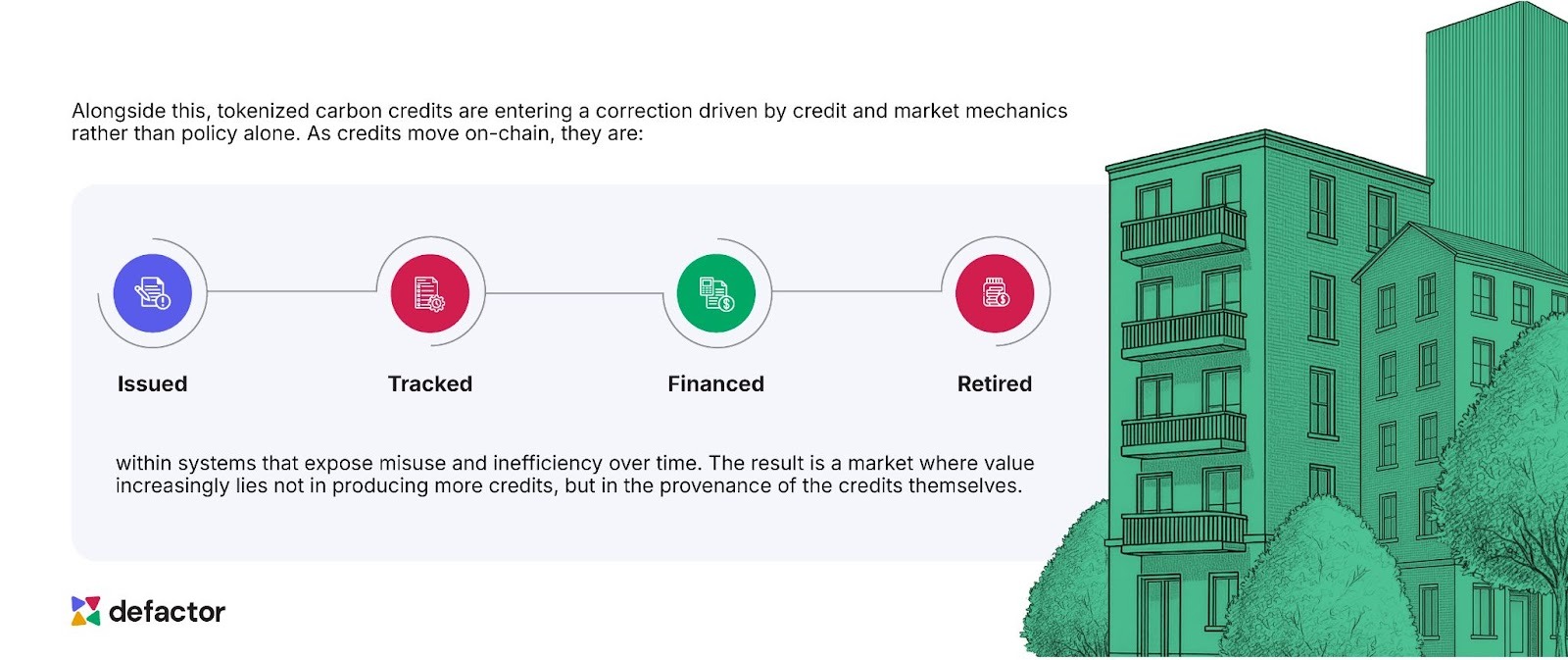
More broadly, tokenized carbon credits and environmental assets are beginning to evolve away from one-off instruments toward living markets. When credits can be issued, retired, financed, or traded within interoperable systems, their value becomes harder to inflate and much easier to audit. The market shifts from storytelling to being able to prove: what exists, what has happened, what can happen next.
These early examples are not yet at global scale, but they matter because they demonstrate a pattern. Green finance does not need louder promises or faster capital. It needs systems that make misrepresentation expensive and stewardship legible. In that sense, RWAs are not rescuing green finance with innovation, they are giving it the foundations sturdy enough to carry the weight of its ambition.
Liquidity & Credit
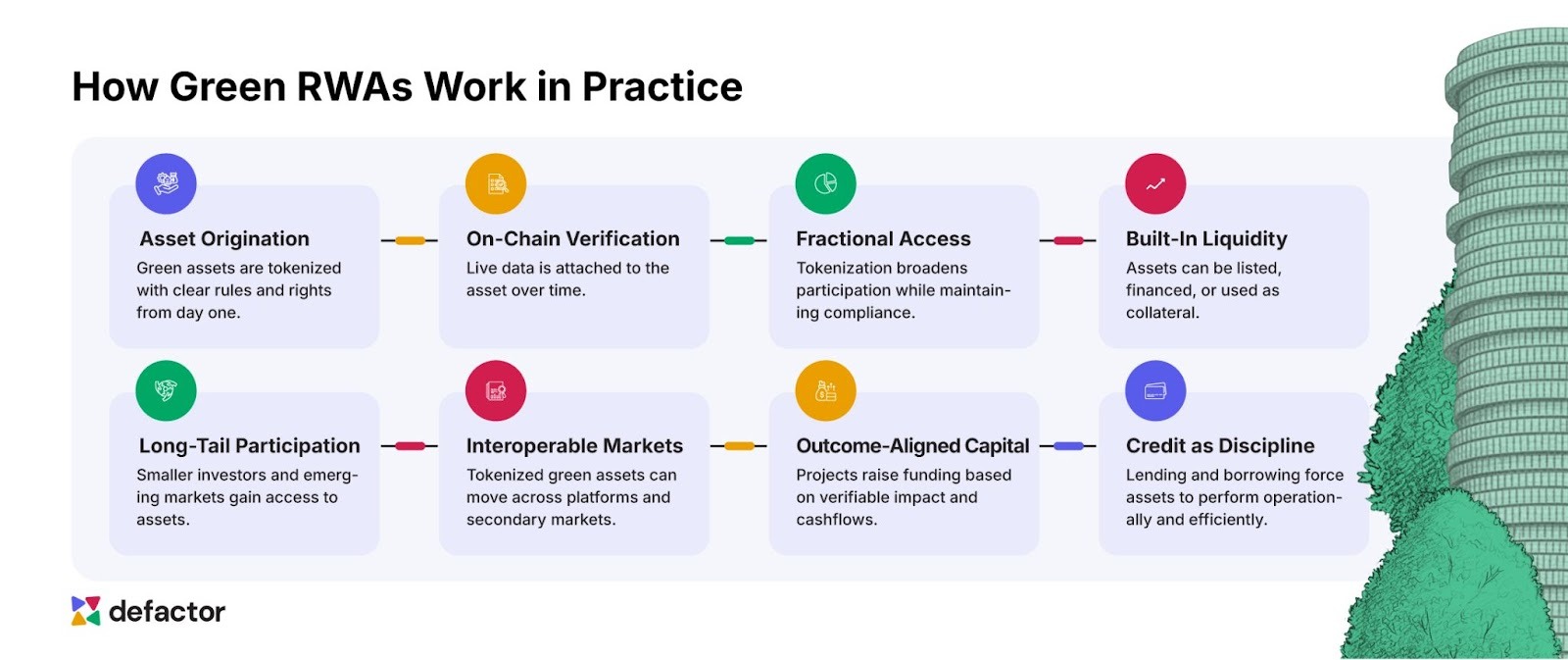
One of the failures of early green finance was that its assets were designed to sit still. Impact was something you bought, held, and reported on annually, not something that moved, responded, or was tested by markets. Without liquidity or credit, green assets remained symbolic rather than functional, respected in theory, but sidelined in practice.
RWAs change this by allowing green assets to behave like real financial instruments without severing their link to reality. Liquidity is no longer an afterthought or some type of a moral hazard. When a tokenized forest can be financed, traded, or used as collateral, it is forced into contact with price discovery and market scrutiny. Poorly structured assets fall apart under this pressure but well-structured ones attract capital. The system, companies and consumers will be able to distinguish substance from surface.
Lending and borrowing against green RWAs introduces discipline that static impact products never faced. To remain capital-efficient, assets must perform operationally, environmentally, and financially. Verification, constraints, and cashflow are vital and credit turns sustainability from a claim into a requirement.
What’s on the Market Today: Early Signals, Real Constraints
What exists today is not a finished green RWA market, but a set of signs pointing in the same direction. The assets currently reaching the market tend to share one trait: they are grounded in things that can be verified repeatedly. Forestry, renewable infrastructure, and environmental credits are not only fashionable, but they also offer easy-to-tokenize data such as growth cycles, production data, and retirement events.
Forestry RWAs sit at the front of this curve. DeFi projects can help in structuring regulated exposure to real forests, combining legal ownership, geospatial data, and on-chain issuance. The asset is not an abstract “green promise,” but a productive system that grows, regenerates, and yields value. Capital enters something observable, constrained, but slow-moving enough to be audited continuously. This makes forests an ideal testing ground for green RWAs: complex enough to matter, physical enough to verify, and long-term enough to punish shortcuts.
Green bonds and renewable infrastructure are also beginning to appear in tokenized form, often with conservative structures and limited liquidity by design. These assets prioritize enforceable cash flows, regulated issuance, and investor protections over speed. While less exciting than speculative markets, they are a sign of maturation. Green RWAs are entering finance through compliance-first pathways rather than trying to circumnavigate them.
What is notable by its absence is the purely narrative-driven green assets. Markets are showing a preference for projects that can withstand scrutiny, operate under credit conditions, and integrate into broader capital systems. This could be tied directly to the filtering process that exists thanks to blockchain technology. Green RWAs that survive early market contact tend to be slower, more structured, and less promotional than their predecessors.
The market today is small, uneven, and incomplete. But it is coherent in a way green finance has never previously been.
Conclusion
- Green finance stalled not from lack of intent, but from lack of enforceable infrastructure.
- RWAs matter because they change what markets can see and enforce, not because they sound greener.
- Liquidity and credit transform sustainability from narrative into requirement.
- The future of green finance depends on market design. Progress will come from building systems that align incentives with stewardship.